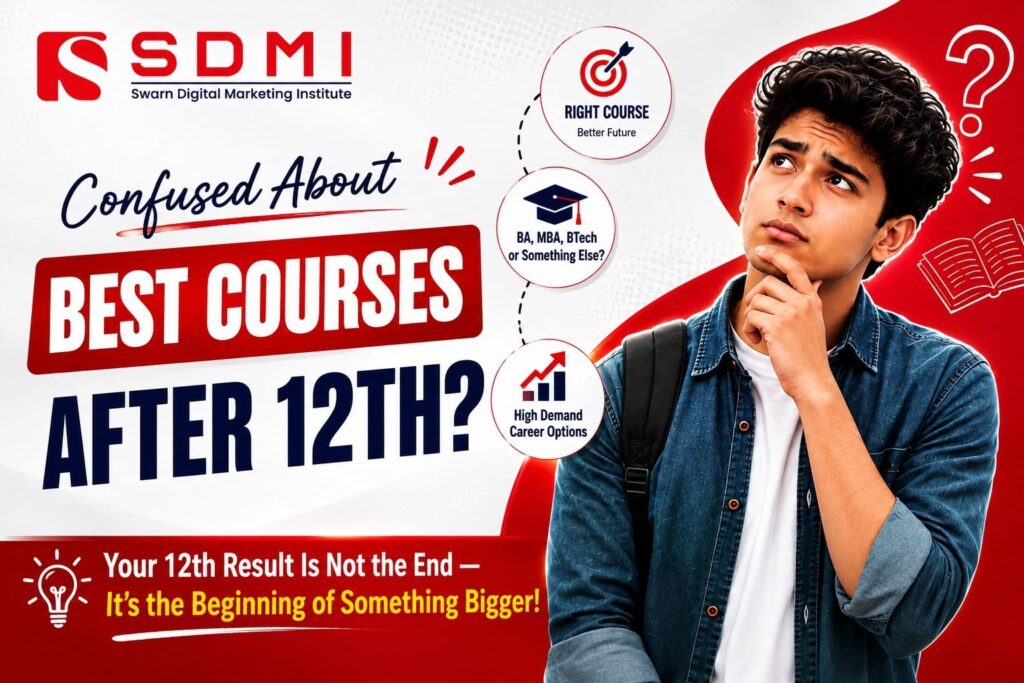
Best Courses After 12th can feel like a surprisingly difficult question to answer. Finishing 12th grade is a milestone, and then comes the quiet, slightly unsettling part — the “what now?” question hanging over every conversation with relatives, friends, and whatever advice you’re pulling from late-night searches. Feeling uncertain here is normal. For twelve years, the path was laid out for you. Now it suddenly branches in a dozen directions, and there’s pressure to pick the “right” one on the first try.
The thing is, the traditional playbook — pick science, commerce, or arts, do a degree, figure out the rest later — doesn’t map as cleanly onto today’s job market as it used to. A lot of the more promising paths right now don’t require four years in a classroom before you’re actually building skills you can use.
If you’re looking for something that balances creativity, strategy, and real career stability, it’s worth taking a proper look at skill-based, digital-first fields before defaulting to the usual options.
Why “Best Courses After 12th” Doesn’t Mean What It Used To
A few years back, this question usually came down to picking a stream — science, commerce, or arts — and following it through to a degree. Those paths still matter and still work for plenty of careers. But the modern job market has added something extra into the mix: employers increasingly want to see what you can actually do, not just what you’ve memorized. The World Economic Forum’s Future of Jobs research has tracked this shift for years — practical, adaptable skills are increasingly what separates candidates, alongside formal qualifications.
That shift has opened up faster, more flexible career tracks — ones where you can start building real experience and a portfolio early, instead of waiting years for your first practical exposure.
When you’re comparing the Best Courses After 12th, look for fields that give you:
- Hands-on training, not just lecture-based learning
- Skills that stay useful across industries and economic cycles
- Room to freelance, consult, or join an established company — your choice
- Enough built-in change that the skill doesn’t go stale in a few years
Why Digital Skills Are Worth Taking Seriously
Among the Best Courses After 12th, digital marketing stands out as a practical option for students interested in learning how businesses actually operate and communicate online.
Every business needs some kind of digital presence to survive — local shops and global companies alike. That means there’s constant demand for people who understand how search engines work, how social media builds trust with an audience, and how content actually connects with people instead of just filling space. This is usually where “best courses after 12th” searches start pointing toward digital marketing and online strategy training.
What Makes Digital Marketing a Smart Pick Right After 12th
For students comparing the Best Courses After 12th, specializing in digital marketing straight out of school can provide an opportunity to start developing practical skills early.Instead of waiting until after a three-year degree to understand how real businesses work, you start building that understanding immediately.
- You learn broadly, not narrowly. Brand storytelling, consumer psychology, SEO, performance marketing, data analysis — it’s not one skill, it’s a connected set of them.
- You can apply what you learn right away. Launch a website, run a small campaign, build a portfolio — all while you’re still learning, not after.
- You’re not locked into one industry. Healthcare, education, travel, fashion, tech — every sector needs digital visibility, so the skill travels with you.
- You get more than one career route. Agency work, freelancing from home, or eventually building your own business — the skillset supports all three.
Where You Learn Matters as Much as What You Learn
When comparing the Best Courses After 12th, free tutorials online can teach you the basics, but structured learning can provide a more organized path. Actually getting good at this takes structured guidance, real projects to work through, and someone with actual experience checking your work and telling you what’s off.
At SDMI Academy, students exploring the Best Courses After 12th can treat this period as a real opportunity to develop practical skills, not simply as a gap to fill.Learning shouldn’t feel like sitting on an assembly line — it should be a space where you’re encouraged to ask questions, actually use the tools, and learn by doing rather than just watching.
A solid digital marketing program should teach you to think strategically, read audience behavior, and adapt as the tools and platforms change — because they will keep changing. When you’re comparing programs, look for ones built around mentor-led guidance and real project work, not just a stack of recorded lectures you watch on your own.
You can check out SDMI’s Digital Marketing Course to see how the training is structured, or get in touch directly if you’ve got questions about eligibility, batches, or fees.
A Calmer Way to Decide
If you’re still comparing the Best Courses After 12th, here’s a simple way to think it through:
- Notice your actual curiosity. Are you interested in why people buy what they buy, how trends spread online, or how a creative idea turns into a real business result?
- Think about how you actually learn. Do you do better sitting through long lectures, or building things with your hands and getting feedback as you go?
- Be honest about your timeline. Do you want career-ready skills within months, or are you fine spending several years in academic study before getting any real-world exposure?
What Are the Best Courses After 12th for Different Interests?
Making the Best Course Choices After 12th will be easier when one starts from his/her interests instead of picking up courses just because other people do. Different students come from different educational backgrounds and have different skills; therefore, it is impossible to find one single course which will suit everybody.
If a student is good with figures, then he/she might be interested in finance, accounting, economics, and analytics. If a student is a tech fan, then he/she might think about programming, web development, and similar areas. Communication skills, creativity, and business thinking will be useful when pursuing a course on marketing or digital media.
It is necessary to take into account one’s interests, personal characteristics, career aspirations, and desired job in the future while deciding on the Best Courses After 12th.
This way, students will be able to avoid the trap of choosing the course which everyone talks about because it is popular and yet does not suit their interests or skills.
Before deciding on any one of the Best Courses After 12th, you need to figure out which career you would be interested in studying for months or years.
Best Courses After 12th for Students Interested in Digital Marketing
For those interested in social media, content, advertising, websites, branding, or online business, digital marketing is something that can fascinate them after completing their education.
Best Courses After 12th for such students can be something like practical digital marketing where the students can be introduced to different aspects of digital marketing rather than learning one single skill from their courses.
Digital marketing can consist of SEO, content marketing, social media marketing, paid advertising, email marketing, analytics, WordPress, and other similar aspects.
The diversity of digital marketing can be helpful for beginners as the students can try their hands at various aspects before deciding which aspect appeals to them the most.
One student can end up liking SEO through keyword research and website optimization while another can enjoy the process of creating social media marketing campaigns. One more student can like paid advertising or analytics due to his/her number-loving nature.
This is just one example why students searching for the Best Courses After 12th should go beyond the names of their courses and know what they can learn from them.
How to Choose the Best Courses After 12th
Best Courses After 12th should be based on more than just the title of the course. It should involve a review of the course curriculum, hands-on experience, duration, learning methods, mentorship opportunities, projects, and career relevance.
First, see what kind of skills you are learning from the curriculum. If the course involves learning about digital marketing, does it include SEO, social media, paid advertising, analytics, content marketing, etc., with assignments and projects involved?
Second, consider the method of learning the course. Some students perform better in classroom settings, whereas some students prefer an online setting for learning.
The third aspect to be considered is practical experience. The Best Courses After 12th should be based on the fact that the students learn how to apply concepts rather than simply memorizing the concepts.
Lastly, take into account what kind of assistance is available post or during the training. This may include mentorship, portfolio creation, interview preparation, and career assistance for students entering the professional world.
Degree Courses vs Skill-Based Courses After 12th
When students are comparing the Best Courses After 12th, they often come across a situation where they have to choose between the regular degree courses and short courses based on skills.
The degree offers formal academic education and could sometimes be mandatory for some career paths. In addition, it allows the students to spend several years studying the subject.
The skill-based course differs in that it usually involves the development of specific practical skills in the chosen area.
Both forms of education do not have to compete against one another. For some students, the skill-based course can go hand-in-hand with the degree.
For instance, the student who is taking the bachelor’s degree can study digital marketing at the same time. This gives the opportunity to gain another skill along with the formal education.
This becomes very important in the case of Best Courses After 12th since students do not always have to choose between these two forms of education.
Skills to Develop Alongside Your Course
In the case of the Best Courses After 12th, it makes sense to consider something beyond just the course program.
Communication is a key factor in virtually all professional spheres. Students should be able to convey their thoughts and opinions in a clear way, talk with clients or colleagues and present their work.
Problem solving is another good skill to have. When doing digital work, there is often the need to try out an idea, evaluate the results, find the problem and try another option.
The skill of time management will also become relevant once students start doing projects and assignments.
Learning new tools is something else that the students should get used to. In the world of digital platforms, things change quite frequently and being able to adapt can be as important as knowing one particular tool.
All these additional skills will contribute to making the learning process more effective.
Career Options After Learning Digital Marketing
Students thinking about the Best Courses After 12th could also be interested in knowing what else they could do with digital marketing courses.
There are many options for learners as to where digital marketing could take them based on their skills.
SEO could help learners find jobs that will require them to research keywords, optimize content, manage technical SEO, and analyze website performance.
Social media marketing could mean working with social media content, communities, strategies, and campaigns.
Paid advertising could include setting up campaigns, managing audiences and budgets, testing, and analyzing the results.
Content marketing could be suitable for those who like writing, researching, storytelling, and communicating.
Analytics could be interesting for students who enjoy working with numbers, reporting, and understanding user behavior.
Freelancing is also an option for students with practical skills. They could work independently on their own projects and cooperate with businesses.
This is one of the reasons why digital marketing pops up often in the search results when students try to find the Best Courses After 12th.
Why Practical Projects Matter After 12th
- Use your knowledge practically: Practicals help the students transform theoretical knowledge gained through books and video lectures into practical skills.
- Gain practical experience: The students can work on keyword research, social media scheduling, advertising campaigns, and web analytics.
- Develop decision-making skills: The students are required to think about audience, purpose, competition, content, budget, and outcomes.
- Develop a portfolio: Students can create their own projects which they can talk about in interviews.
- Have an understanding of how it is really done: The students can describe what they have done, what problems did they face, and what have they learned.
- Select the Best Courses After 12th: While selecting the Best Courses After 12th, consider those that involve practical assignments.
Common Mistakes Students Make After 12th
While searching for the Best Courses After 12th, some students may decide based solely on trends.
Choosing a course simply because your friends are opting for it can be one such mistake. The interests of your friends might be totally different from yours.
Another mistake could be making a decision on the basis of salary claims alone. Career growth depends on several other factors.
Some students may also go for a course without considering its curriculum. A course with an attractive name might have little practical exposure in reality.
Another mistake could be thinking of instant results. It takes time to learn any professional skill.
This requires time to learn about things, do assignments, make mistakes, and learn from them.
This is why you should select the Best Courses After 12th after assessing the learning process involved.
How to Build the Right Skills After 12th
After choosing the Best Courses After 12th, you must consider what to learn and how to implement it in your career. It is important for students to learn about developing practical skills along with their courses.
Learn communication skills: Learn writing skills, speaking skills, presentation skills, and professional communication skills.
Learn digital skills: Learn about digital tools like analytics tools, content tools, social media platforms, and website building tools.
Practice projects: Implement your classroom learning by doing practical projects, campaigns, case studies, and portfolio projects.
Learn problem-solving skills: Learn how to identify a problem and find its solution.
Make a portfolio: Collect all your practical work, project work, certificates, and other practical work.
Keep yourself updated: As digital industries evolve fast, keep updating yourself with the latest tools and trends of the industry.
Gain confidence through practice: Practice makes perfect and regular practice will help you to implement your theoretical knowledge into practical skills.
There’s no need to rush this out of panic or pressure from people around you. Take some time, look at what industries are actually hiring for right now, and pick a direction that gives you real, usable skills and room to keep growing.
If you’re after a career that mixes strategy, creativity, and long-term stability, a structured digital marketing course is genuinely worth exploring as your next step — start here if you want to see what that could look like.