

We get this question a lot: does learning search engine optimization still make sense now that AI is everywhere?
When tools like ChatGPT, Gemini, and Perplexity can just hand you an answer without you clicking a single link, it’s a fair thing to wonder. Plenty of students and working professionals hesitate before signing up for an SEO course, worried they’re about to learn rules for a game that’s quietly winding down.
From where we sit, that’s not really what’s happening. Search isn’t dying — it’s changing shape, and honestly changing faster than it has in years. Still, understanding how people find, use, and reference information on the Internet is one of those skills that remains reliable and valuable to learn in an effective SEO Course.
What’s Actually Changed in Search
A modern SEO Course should move beyond these outdated strategies and explain how the search process has evolved. Find some popular keywords, sprinkle them across a page in the right spots, build a handful of links, wait for your ranking to climb up the list of ten blue links. That was more or less the game for years.
AI-driven answer engines don’t work that way. Instead of matching exact keyword phrases, they’re looking for authoritative sources, structured facts, and content with real context behind it — not just the right words in the right place.
The shift has definitely introduced two additional components that every contemporary SEO course must include:
Answer Engine Optimization (AEO) — structuring content clearly enough that search systems can pull a direct definition, a bullet list, or a quick solution straight into a summary box.
Generative Engine Optimization (GEO) — building actual authority through original work and clear context, so AI models choose to cite you when they’re generating an answer for someone.
None of this makes SEO skills obsolete. If anything, it raised the bar. Keyword stuffing is dead, sure, but knowing how to structure and organize information strategically matters more now than it did five years ago.
Why Taking an SEO Course Still Matters
With AI able to craft a paragraph in seconds, why should you take an SEO Course? Because there’s a real gap between generating text and actually driving results for a business — and that gap is where the value sits.
AI tools still need direction. Generative AI is genuinely good at drafting sentences, but it has no real grasp of user psychology, a business’s specific goals, or a website’s technical health. With an effective SEO course, you learn how to prompt the tools, evaluate their results, and create content that matches what consumers want—not just what sounds plausible.
Technical problems don’t fix themselves. No AI model will repair a broken site structure, fix slow load times, or untangle bad mobile navigation. An Effective SEO Course will also impart to you the basics – site structure, schema markup, crawlability – that will make your website readable for not only search bots but also AI crawlers.
E-E-A-T still matters, maybe more than before. Search platforms and language models both lean toward content that shows genuine human experience and expertise. Building the kind of trust signals and earned citations that come with real authority isn’t something you can automate — that part’s still on you.
What a Course Worth Taking Should Actually Cover
In case you happen to be considering an SEO Course at present, ensure that the course content incorporates the present workings of search, and not just some old checklist.A successful SEO course designed for today’s environment must teach you how to:
- Research topics by intent, not just by keyword volume — mapping out full topic clusters instead of chasing a list of phrases
- Write answer-first content — a clear, direct lead that answers the question, followed by detail backed by real experience
- Use AI tools sensibly — for research and workflow, while keeping the actual voice and judgment behind the content human
- Track visibility across more than one channel — traditional search results, AI-generated summaries, and referral traffic alike
What You Should Actually Learn in an SEO Course
A Contemporary SEO Course should provide you with an understanding of the process of search from a variety of angles. Modern SEO is not only about the search for keywords and placement in headings. An adequate learning process should also give you knowledge of the relationships between the searcher, the site, the content, the search engine, and increasingly, AI-based discovery platforms.
Keyword Research and Search Intent
Keyword research is still relevant, yet the approach to it has somewhat changed. Rather than making a table with hundreds of phrases and using all of them, the contemporary SEO approach focuses more on understanding the reason behind each search.
For instance, when people search for “SEO course,” they look for the appropriate training course. The same people can be looking for the same phrase but with a preposition “how to do,” which means they want to know how it should be done. Others can be looking for “SEO course near me.”

On-Page SEO
On-Page SEO involves those factors that make it possible for a search engine to comprehend what a certain webpage is all about. These include title tags, headings, content structure, URLs, internal links, images optimization, meta data, and information structure.
However, optimizing should not mean making a webpage sound unnatural.
When paragraphs are created using a particular keyword instead of the question posed by a user, it becomes hard to read. It is necessary for modern SEO to combine both optimization and usability.
It is therefore important for students to learn how to insert keywords in a natural way but still maintain usability.
Technical SEO
Technical SEO is something that intimidates many newcomers, as it deals with the website as opposed to its content alone.
A useful SEO Course should cover topics such as crawling, indexing, website architecture, redirects, canonicalization, XML sitemaps, robots.txt files, page speed, mobile usability, structured data, and internal linking.
It is not absolutely necessary for you to be a developer to deal with technical SEO. What is important is for you to know what those elements do, and when an issue with one of them might interfere with the search engines’ ability to crawl or index your website.
Content Strategy
Content continues to play an important role in the field of SEO, however, it is not always a solution to create more content.
A new approach to content strategy involves asking several questions. What do the people want? What kind of information is available? What is lacking? What can the company offer? Which subjects require separate pages and which can be discussed on the same page?
It is crucial for students to master such content formats as topic clusters, content calendar, supplementary pages, FAQ, comparative articles, guides, and others.
Such a method will make it simpler to prevent the creation of tens of very similar pages.
Link Building and Authority
Links are still an important aspect of the discovery and evaluation of websites, but modern SEO needs to take into account a more considered approach to the concept of authority.
A student should know how to distinguish between obtaining relevant citations and the accumulation of many poor links. Outreach, digital PR, collaboration, useful tools, expert opinions, and valuable content can all be involved in creating a site’s authority.
The key point here is that links should serve only as part of a strategy rather than being the whole strategy itself.
Analytics and Reporting
The SEO specialist must also know what has occurred after the optimization work is done.
Search impressions, clicks, rankings, organic traffic, engagement, enquiries and conversions may give different pieces of the puzzle. Focusing on one single figure might be misleading about performance.
For instance, traffic may rise without generating enquiries. There may be an improvement in the ranking position of certain keywords, whereas other commercial keywords stay the same. The page may get impressions, but not many clicks as there is no correlation between the title and description.
Knowing how to analyze these factors will allow the SEO specialist to make a decision rather than give figures.
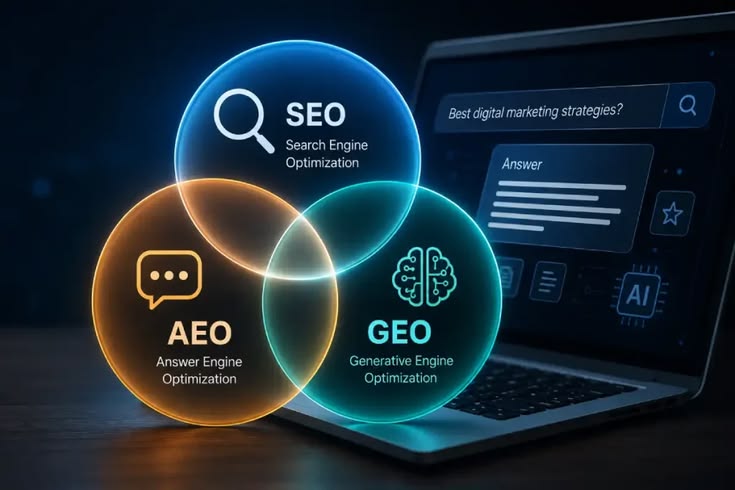
SEO, AEO and GEO: What’s the Difference?
Information discovery can happen in a number of ways today.
Classical SEO revolves around enhancing visibility on search engines. AEO (Answer Engine Optimization) is concerned about the structure of information in such a way that systems can answer the queries of users.
GEO (Generative Engine Optimization) is the term usually employed to refer to efforts made toward enhancing representation/referencing of content in generative AI.
All three methods overlap but are not necessarily substitutes for classical SEO.
How SEO Professionals Are Working With AI
AI has changed the work of an SEO specialist because it makes some steps much faster. For instance, research that would normally take hours could be better organized, and a marketer could use AI to come up with initial ideas, find gaps in the content, summarize information, or write first drafts.
However, speed doesn’t automatically mean high quality.
A quality SEO Course will help you learn to treat AI as an assistant and not a replacement for SEO thinking. It still takes time to ensure the topic is relevant, understand what the searcher needs, verify data accuracy, and explain why the content is better than the top-ranking pages.
For instance, AI could compile a list of questions relevant to the subject matter. The SEO specialist then analyzes these questions, determines search intent, confirms they’re truly relevant to the target audience, and structures them into a coherent content plan.
In the same way, you could use AI to create a draft of your content, but there will be somebody else who would have to validate the information provided, add examples, improve structuring, cut down on general statements, and inject personal experience into it.
That is what makes modern SEO much more fun. You do not have to spend your precious time on routine tasks anymore.
What Students Can Expect to Learn in a Modern SEO Course
Today’s student enrolling in an SEO Course should not expect to learn only about keywords. The scope of SEO includes content, websites, searching behavior, technical SEO, analytics, and the use of artificial intelligence in workflow.
The logical way for a beginner to start is to get familiar with the basics of how search engines find, interpret and rank web pages. The next step is then to learn about keyword research, search intent, competitive analysis, content development, on-page SEO, internal linking, technical SEO and performance tracking.
It is also helpful for a beginner to know how websites convey information to search engines. Such things as crawlability, indexing, redirection, canonical links, structured data, mobile friendliness and website structure may seem technical at first glance, but their meaning becomes clearer once examples are seen.
Another component of the learning process is the development of the content. The students need to learn how to develop the content according to users’ queries rather than adding a keyword over and over again. One can practice in building blogs, making headings, working with the meta data, improving the internal links and identifying gaps in the content.
The modern learning program needs to include analytics and reporting. The traffic to a page is not enough information for an SEO specialist. It is necessary to analyze such factors as impressions, clicks, rankings, engagements, conversions and others to identify whether one’s efforts produce results.
Finally, it is important for students to know about the role of AI in search and content discovery. In this way, the knowledge of AEO and GEO along with SEO will give an understanding of why answers, sources, original information and topical authority become so important today.
SEO Skills That Can Remain Useful Beyond 2026
Another reason for hesitation regarding the acquisition of SEO skills is that the platform itself and the approach to it can change drastically. However, a solution that works now may become useless after the updates of search engines. Nevertheless, this does not mean that SEO skills will not be relevant anymore.
The eternal side of SEO is knowing how to find out what audience needs and link it with valuable information.
How to perform SEO analysis, learn how to explore the search intent, how to analyze website, how to find the content gaps, optimize pages, check competitors and analyze results can remain valid even if the tool changes.
Just compare the process of learning a special button of software with learning the reasons why you are using this software.
This is the reason why the choice of SEO Course is so vital. A course designed to teach nothing but memorization of ranking tricks that might no longer work in the future search environment will be hard to implement then. It will provide a more comprehensive perspective to deal with all that.
For beginner students, this will also be an important mindset adjustment. You don’t have to know all SEO tools in advance. You have to learn the basics, practice them in the real-life websites or projects, and slowly get used to tools used to carry out this practice.
It’s not about being able to predict everything that Google or AI platform can think of next. It’s about being able to comprehend what was changed, why it happened, and what adjustments should be done.
So, Is It Still Worth It?
Yes — as long as the course treats AI as something to work with, not something to panic about. The mechanics of how content gets found online are a genuinely durable skill. Platforms and algorithms will keep shifting — Google’s own Search Central blog documents these changes constantly — but the underlying need for businesses to be found by the right people isn’t going anywhere.
There is no doubt that the application of AI technologies is significantly altering the way in which information discovery is carried out. Search results, answer engines, and new uses of AI by marketers are all evolving.
This just means that SEO education becomes even more vital, not less vital.
While a student who is only able to insert keywords into articles may have difficulty with a shifting search algorithm, one who understands the reasons for searches, communication via web pages, content that fulfills user intent, and performance metrics will have a stronger base to work from.
Build Skills That Actually Hold Up — With SDMI Academy
To understand today’s search landscape, an SEO course gives you a framework for content optimization and how AI fits into the bigger picture. Instead of getting stuck on outdated tactics, learning from people who do this work day to day makes a real difference.
At SDMI Academy, the SEO and digital marketing modules are built around practical, real-world application — not theory that expires the moment an algorithm updates. The focus stays on how search platforms, user intent, and AI tools work together, so what you learn holds up no matter which tool is trending this year.
You can look through the SEO course options directly, or head to sdmiacademy.com to check upcoming batches and see what fits your schedule.
SEO learning in 2026 is not about anticipating how the search landscape will be in five years’ time. It is about getting the fundamentals so that you can adjust once the changes occur.
The technologies will evolve. The interfaces for searching will evolve. AI technologies will evolve.
Understanding your audience, useful information, web sites, and results will always count.